
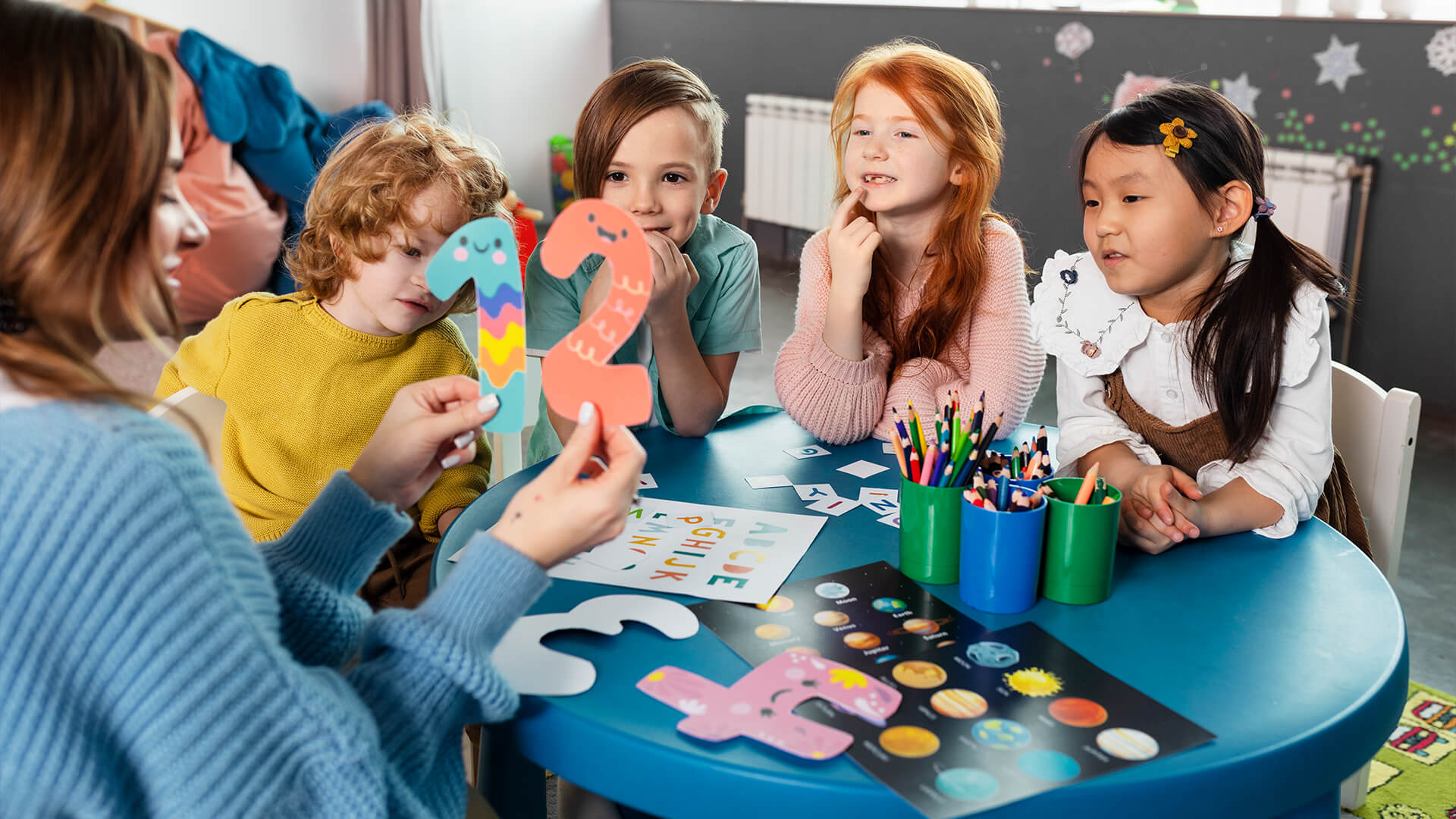

The Core Difference: Concrete Before Abstract
In a traditional preschool math lesson, a child looks at the number 7 on a worksheet and fills in the blank.
In Montessori, a child first counts 7 red beads. Then groups them with a number rod. Then places a golden bead bar of 7 next to a numeral card. Only after this physical experience does the symbol become meaningful.
This is not slower. It is deeper.
The Montessori Math Materials
Number Rods
Ten wooden rods, each one unit longer than the last. Children physically experience the difference between 5 and 8 before they ever write those numbers. The relationship between quantities becomes intuitive.
Sandpaper Numbers
Numerals 0-9 in sandpaper. Children trace the number while saying its name, building a physical memory of each symbol through touch.
Spindle Boxes
Compartments labeled 0-9. Children count real wooden spindles and place them in the correct compartment. Zero — a notoriously abstract concept — becomes real: it means empty.
Golden Bead Material
Single beads (ones), bead bars (tens), bead squares (hundreds), and bead cubes (thousands). Children build four-digit numbers physically. Place value is experienced before it is named.
Bead Chains
The 100 chain (100 individual beads) and the 1000 chain allow children to count in long sequences, building skip counting and multiplication foundations through physical movement.
See these materials and more in our classrooms: view our gallery.
What Traditional Math Gets Wrong (and Why)
Traditional math curriculum in preschool and kindergarten often rushes to symbols. Children memorize facts without building understanding.
The result? Children who can recite that 7 + 8 = 15 but cannot tell you why — or visualize what that even means.
When math gets harder — fractions, algebra, geometry — children without that foundation hit a wall. Montessori children, by contrast, often describe math as logical and intuitive, because for them it literally is.
What the Research Shows
A 2006 study found Montessori preschoolers demonstrated significantly higher math scores than traditional preschool peers by age 5. More importantly, those differences held through elementary school.
The advantage was not drill. It was understanding. Children who handle math in their hands do not forget math with their minds.
Math That Transfers to Real Life
Practical life activities in Montessori are not separate from math — they are math in disguise.
Pouring water to fill three glasses equally is liquid measurement. Setting the table for six children involves one-to-one correspondence. Sorting beads by color introduces basic data classification.
Math is woven into everything. Children do not experience it as a subject. They experience it as a natural part of how the world works.
Learn more about how we integrate math into our full program: explore our curriculum.
FAQ
Q: At what age does Montessori introduce math concepts?
A: Math in Montessori begins as early as age 2.5-3 with number rods and counting activities. By age 4-5, children are working with four-digit numbers and basic operations using the golden bead material.
Q: Is Montessori math good for children who struggle with numbers?
A: Often exceptionally so. Children who struggle with abstract math frequently thrive when they can physically handle quantities. The concrete approach removes the frustration of pure symbol manipulation.
Q: Does Montessori math prepare children for traditional school math?
A: Yes. Montessori math builds a deeper number sense and more flexible mathematical thinking than traditional methods, which prepares children well for any math curriculum they encounter later.
Q: What is the golden bead material?
A: A set of beads representing ones, tens, hundreds, and thousands. Children use them to build, exchange, and decompose large numbers physically, creating an intuitive understanding of place value.
Q: Do Montessori children use worksheets at all?
A: Occasionally, and only after a concept has been fully explored with materials. In Montessori, paper is for recording understanding — not building it.
See Montessori math in action. Book a classroom observation visit at Prep Montessori Academy. prepmontessori.com/contact/