
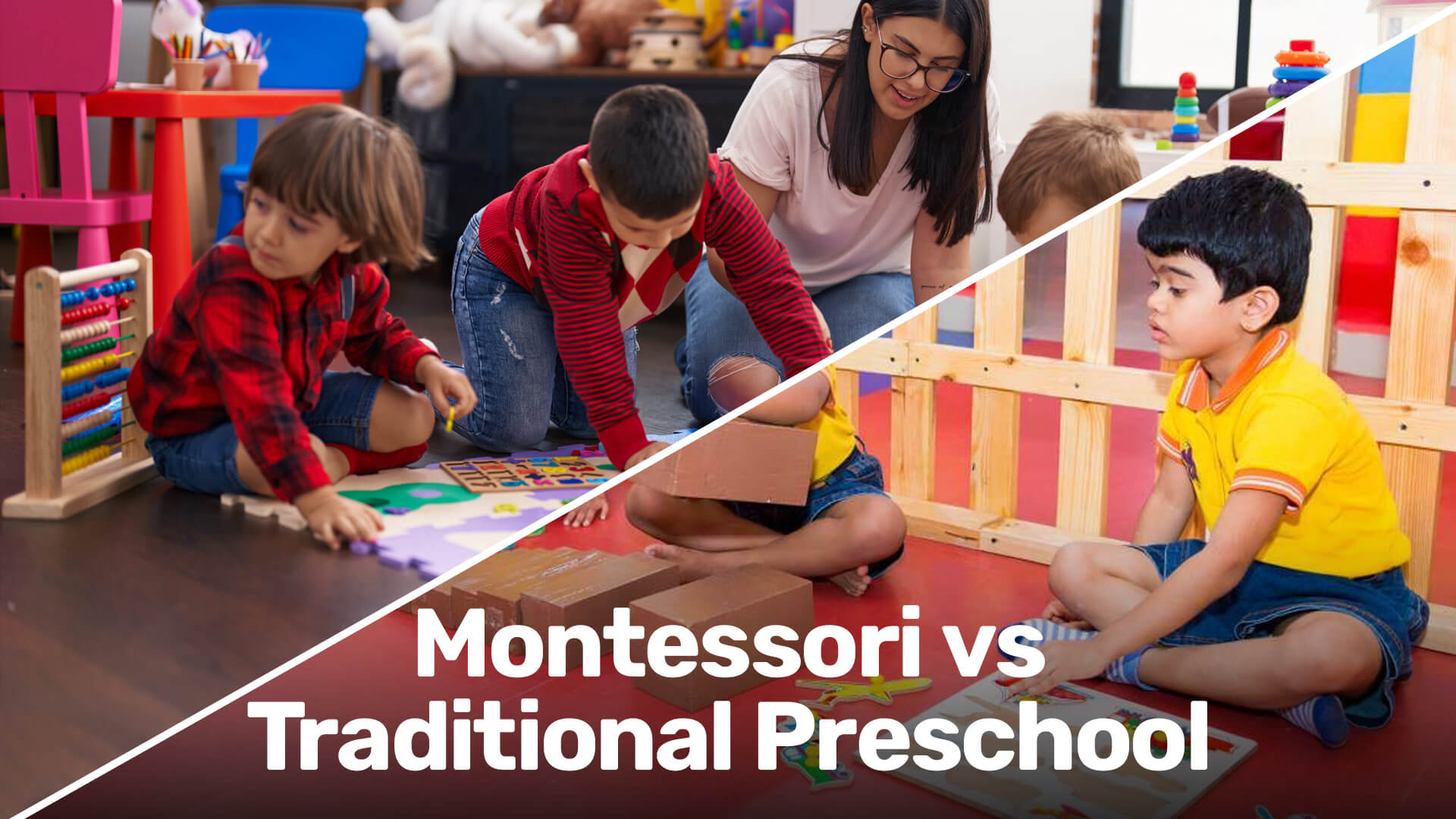
The Core Philosophy Difference
Traditional preschool is built around the teacher. The class moves together: storytime at 9 AM, art at 10 AM, snack at 10:30.
Montessori is built around the child. A 3-year-old who is fascinated by pouring exercises can spend 45 uninterrupted minutes perfecting that skill — because deep focus is the goal.
One approach manages time. The other follows the child’s natural learning rhythm.
What This Looks Like Day-to-Day
- In a traditional classroom: the teacher introduces a concept, children practice together, and move on as a group.
- In a Montessori classroom: children choose from prepared materials, work at their own pace, and self-correct through the materials themselves.
- In a mixed-age Montessori room: a 5-year-old teaching a 3-year-old how to use the sandpaper letters is completely normal — and deeply beneficial for both.
Key Differences: Side by Side
Learning Style: Montessori is self-directed. Traditional is teacher-directed.
Classroom Setup: Montessori uses activity stations. Traditional uses rows or group tables.
Assessment: Montessori observes each child individually. Traditional uses standardized tests and report cards.
Age Groups: Montessori mixes ages (3-6 in one room). Traditional groups children by single year of birth.
Teacher Role: Montessori teachers guide and observe. Traditional teachers instruct and lead.
Materials: Montessori uses hands-on, concrete materials. Traditional uses worksheets and textbooks.
What the Research Says
A landmark study published in Science followed 59 children in a Montessori program versus a traditional program. By age 5, the Montessori children showed significantly better reading, math, executive function, and positive social interactions.
Another study from the University of Virginia found Montessori preschoolers had stronger literacy and numeracy skills by kindergarten, particularly among children from lower-income backgrounds.
This is not magic. It is design. The Montessori environment is built to engage a child’s natural curiosity at exactly the right developmental window.
What Parents Actually Notice
At Prep Montessori Academy
Parents tell us the same thing, over and over: their child becomes a different learner.
- Children arrive excited, not reluctant.
- They start making decisions at home with more confidence.
- They stop asking to be entertained — they start creating.
Want to see this yourself? Schedule a tour of our classrooms and watch the difference in real time.
Which One Is Right for Your Child?
Here is an honest answer: Montessori is not for every family.
If you value a highly structured, academically regimented early childhood with clear milestones and homework, a traditional program may align better with your expectations.
But if you want your child to develop a genuine love of learning, deep independence, self-discipline, and the ability to think critically before they can even read — Montessori delivers that.
Explore our Montessori programs to learn what a day at Prep Montessori looks like.
FAQ
Q: Is Montessori better than traditional preschool?
A: Research consistently shows Montessori children develop stronger executive function, reading, and social skills by kindergarten. However, the ‘better’ choice depends on your child’s temperament and your family’s values.
Q: Can a child transition from Montessori to traditional school?
A: Yes. Montessori children typically adapt well to traditional schools. Their self-discipline, curiosity, and ability to work independently become genuine advantages.
Q: Is Montessori too unstructured?
A: Montessori has deep structure — it is just child-centered structure. The environment, materials, and daily rhythms are carefully designed, even when children appear to be freely choosing their work.
Q: What age can a child start Montessori?
A: Most Montessori programs accept children at age 2.5 to 3. Starting early allows children to benefit from the sensitive periods of development that Montessori is specifically designed to support.
Q: Does Prep Montessori Academy accept children with no prior Montessori experience?
A: Absolutely. Most children who join us have never been in a Montessori environment. Our trained teachers guide each child individually through the transition.
See the Montessori difference for yourself. Book a campus visit at Prep Montessori Academy today. → prepmontessori.com/contact/